



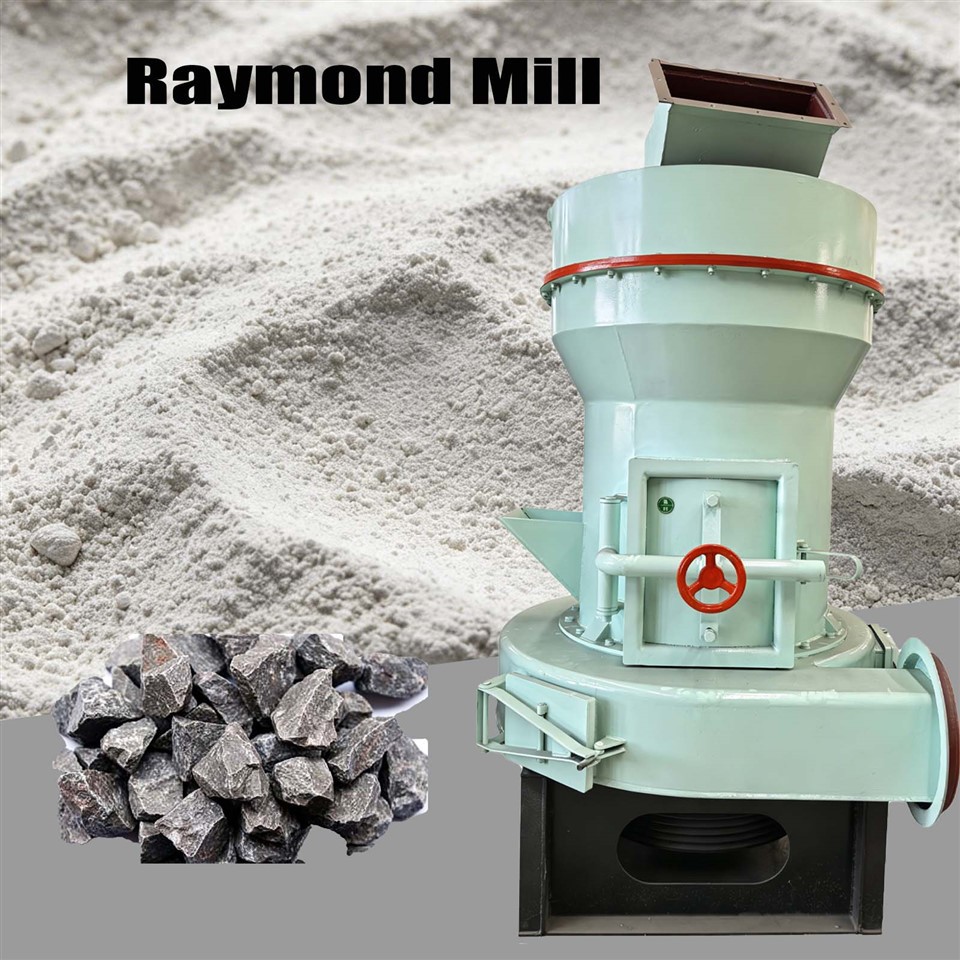


Raymond Mill Machine
Look, here's what a Raymond mill really is: a closed‑circuit system built specifically for non‑metallic minerals. Not a "universal grinder" – tailored.
Its job? Simple. You feed it rock, it gives you powder. But the catch is in the quality. The powder comes out uniform and stable. No wild swings in particle size as you get with cheaper gear – you know, that frustrating mix of fines and coarse lumps.
Rule of thumb: if the mineral isn't flammable or explosive, hardness ≤9, moisture under 6% – you're good to go. Think ground calcium carbonate, talc, gypsum, potash feldspar. Those are the daily bread.
And fineness? You can dial it from 80 mesh up to 600 mesh. How? On a real machine, you tweak the classifier rotor speed and adjust the fan airflow. Get those two right, and the cut point stays sharp – no guesswork.
High Quality
Advanced Equipment
Unique Design
Wide Range of Applications
high quality
Equipped with an integrated dust removal system, it minimizes dust emission and fully complies with environmental standards.
Advanced Equipment
This device features adjustable fineness (80–600 mesh).
Unique Design
Compact Structure, Small Footprint, Simple Installation and Commissioning
Wide Range of Applications
Suitable for medium-to-low hardness non-metallic minerals such as limestone, calcite, gypsum, and talc (with a Mohs hardness of less than 9).
Parameter Table Display
| Model | Number of Grinding Rollers | Max. Feed Size (mm) | Finished Product Fineness (mesh) | Hourly Capacity (t/h) | Main Motor Power (kW) | Blower Power (kW) | Classifier Power (kW) | Weight | Size (m) |
|---|---|---|---|---|---|---|---|---|---|
| 3R1510 | 3 | 10 | 80–325 | 0.3–1.2 | 7.5 | 5.5 | 1.1 | 1.8t | 3.8×3×3.8 |
| 3R2615 | 3 | 20 | 80–325 | 0.5–2.7 | 18.5 | 15 | 2.2 | 3.8t | 4.8×4×4.8 |
| 3R/4R3016 | 3/4 | 20 | 80–325 | 0.8–5 | 30 | 30 | 2.2 | 4.8t | 4.8×4×4.8 |
| 4R3216 | 4 | 25 | 80–325 | 1.0–8 | 37 | 30 | 5.5 | 10t | 7×6×6 |
| 4R3220 | 4 | 28 | 80–400 | 1–10 | 45 | 37 | 5.5 | 10t | 7×6×6 |
Why is this device worth buying?
1. Low investment, quick payback – here's what that really means.
You're not just buying a mill. You're getting a complete powder line in one chassis. No separate feeder, no extra classifier, no dedicated conveying system to piece together. That slashes your civil work and auxiliary equipment costs. For a small-to-medium plant, this cuts the initial cash bite by roughly 40% compared to building a traditional line from scratch. Less pressure on your working capital – and you start selling powder months earlier.
2. Power hungry? Not this one.
We're talking 30%+ less electricity than a ball mill of similar throughput. Run it two shifts a day, and the monthly power bill difference pays for one operator's salary. After a year? That's real margin back in your pocket. I've seen plants retrofit from ball mills to Raymond – their payback on the switch alone came inside 12 months just from energy savings.
3. Tough where it counts, simple to keep running.
The failure rate is low because the design is stubbornly simple. Only a few wear parts – mainly the grinding ring and rollers. Change them during a planned weekend shutdown, not in an emergency at 2 AM. Routine maintenance? A greasing schedule and checking the analyzer blades – that's it. Downtime stays under 5% if you're half‑decent at upkeep.
4. Fits in tight spaces, bolted down fast.
Footprint is tiny – roughly 25 m² for the whole unit, including the dust collector. And installation? Pour a simple concrete pad, anchor it, and connect power and air pipes. No multi‑story steel structure like a ball mill is needed. You can go from delivery to the first batch of powder in under a week.
5. Set it and forget it – almost.
Automation handles the start‑stop sequence, feeder speed matching, and classifier adjustment. One operator can babysit three units simultaneously. Manual labor is basically just loading the hopper and checking the bagged product. For plants struggling to find skilled mill hands, that's a game-changer.

What materials are processed by a Raymond Mill Machine?
Non‑metallic mineral deep processing – that's your heavy calcium, light calcium, talc, gypsum, kaolin. What do they have in common? They all end up as functional fillers. Plastics, coatings, rubber, paper, ceramics – you name it. But here's a tip: light calcium clogs more easily than ground calcium. So if you're running a Raymond mill on it, watch your moisture. Keep it bone dry.
Building materials and cement – limestone powder for desulfurization at power plants, gypsum for wallboard, putty powder, and cement raw meal. The desulfurization stuff? 250 mesh or 325 mesh, nothing fancy. But cement plants are picky about the particle size curve. Too many fines and your set time drifts.
Chemicals and metallurgy – phosphate rock, manganese ore, pulverized coal, metallurgical auxiliaries, refractories, activated carbon. Phosphate is abrasive. Eats through grinding rings faster than you'd think. Plan a ring change after 600–800 hours if you're running it daily.
Environmental protection / solid waste utilization – slag, steel slag, granulated blast furnace slag (GBFS). Grind it to ultrafine powder, and it becomes a high‑performance concrete admixture. The catch? Steel slag is tough – high iron content kills mills if you don't dial down the feed rate. GBFS is friendlier, but dry it first. Moisture above 2% and your separator chokes.

The finished product of a Raymond mill consists of ultrafine powders ranging from 80 to 325 mesh (with some varieties reaching 400 to 600 mesh). Characterized by uniform fineness and a high screening pass rate (up to 99%), the material typically presents as a fine, delicate powder-white or light gray in color-devoid of any perceptible graininess.

Typical Application Industries – where this mill actually earns its keep.
Building materials: Cement, putty powder, gypsum board.
Cement plants want their raw meal fine but not too fine – 80 to 120 mesh usually does it. Putty powder? That's a 325 mesh game. And gypsum board? You grind it to 150–200 mesh, but keep the temperature low. Too hot and you lose the crystal water – then your board won't set.
Chemicals: Rubber, plastics, coatings, paper fillers.
Here's the dirty secret: paper filler needs high whiteness, not just fineness. So if your calcium carbonate has even a hint of grey, don't bother bidding. Rubber and plastics care more about the top cut – anything above 20 microns ruins the surface finish.
Environmental protection: Desulfurization limestone powder.
Power plants are picky. Has to be 250 mesh or 325 mesh, with a tight distribution. Pass rate at 325 mesh? 90% minimum, or they'll reject the whole truckload. And moisture under 0.5% – sticky limestone clogs the injection lance like nothing else.
Metallurgy, glass, and ceramics: Raw materials.
Metallurgical auxiliaries – think quartz, fluorite, feldspar. Glass batch needs iron content below 0.1%, or your finished glass turns green. Ceramics? They screen out anything coarser than 200 mesh. Miss that, and your glazed surface develops pinholes.
Feed and fertilizer additives: Calcium powder.
Chickens need grit – that's coarse 30–50 mesh. But for premixes? 60–100 mesh limestone flour, strictly. And never, ever let it get damp. Caked calcium in feed means blocked augers and angry mill managers.

What are the features?
High Quality
This isn't just a mill – it's a standalone milling system. Feed it raw material at one end, collect finished powder at the other. No extra conveyors, no separate classifiers to piece together. The footprint? Tight. The structure? Solid – welded steel plate, no flex under load. You can park it in a corner of an existing plant and still have room to walk around.
Customized Design
Even fineness? That's the headline. But here's the real kicker: the screening pass rate hits 99%. Try that on a ball mill – you'll be lucky to see 85% at the same mesh. What does 99% mean on the floor? Less rework, less rejected product, and your customer stops complaining about oversized particles clogging their filters.
Good Performance
Look inside the drive train. Sealed gearbox plus pulleys – not an open gear setup that drinks dust and spits out grease every shift. The seal keeps fine powder out of the bearings. Result? Smooth transmission, no unexpected breakdowns. You'll change the oil once a season and forget about it.

Introduction to Related Machinery and Production Lines

I. Overall Process Flow – From Rock To Bag.
Raw Material Crushing → break the big lumps down to under 30 mm. Skip this step, and your mill chokes.
Lifting & Conveying → bucket elevator or belt? Belt is gentler, but takes more floor space. Your call.
Quantitative Feeding → a screw feeder or a vibratory feeder with a variable drive. Set the rate right, or the mill either starves or floods.
Main Mill Grinding – this is where the suspended rollers do the real work. Crush, shear, repeat.
Classification & Separation → the classifier spins at a set RPM. Too slow? Coarse particles sneak through. Too fast? Output drops.
Finished Product Collection → cyclone plus bag filter. Cyclone catches the heavy stuff; the bag filter grabs the fines that would otherwise float away.
Dust Removal & Purification → the last line of defense. Keep your stack clean, or the environmental inspector starts asking questions.
All of the machines listed above are currently available for sale from our company. They may be purchased individually or as a complete production line. We welcome you to contact us for inquiries.
What are the advantages of choosing Lerford?
One‑Stop Service of Raymond Mill Machine – the kind that actually saves you headaches.
You want customization? We'll spec it to your feed stock and target mesh. No cookie‑cutter machines.
Free site planning and line design – we'll send a layout drawing before you pay a cent.
Full machine warranty + long‑term spare parts supply – genuine originals, not knockoffs that wear out in half the time. And when you call? Responsive support. Not a ticket system that disappears for three days.
Flexible payment, low entry barrier – here's how it actually works: pay a deposit (typically 30% to 50%) to start production. The balance? Due when the machine is loaded onto the truck, ready to ship. That eases your cash flow significantly – you're not bleeding money for six months before seeing a single flange.
Seamless integration – elevators, screw feeders, dust collectors, storage hoppers – we supply the whole train. One PO, one contact person, one startup. No chasing five different suppliers because the bucket elevator doesn't match the mill inlet.
Bottom line: It's a complete powder line solution, not just a mill with a few add‑ons.
 |
 |
 |
 |
Our Raymond mill has already served numerous countries, including Bangladesh and Ecuador.
Hot Tags: raymond mill machine, China raymond mill machine suppliers, factory, Crusher Machine


