

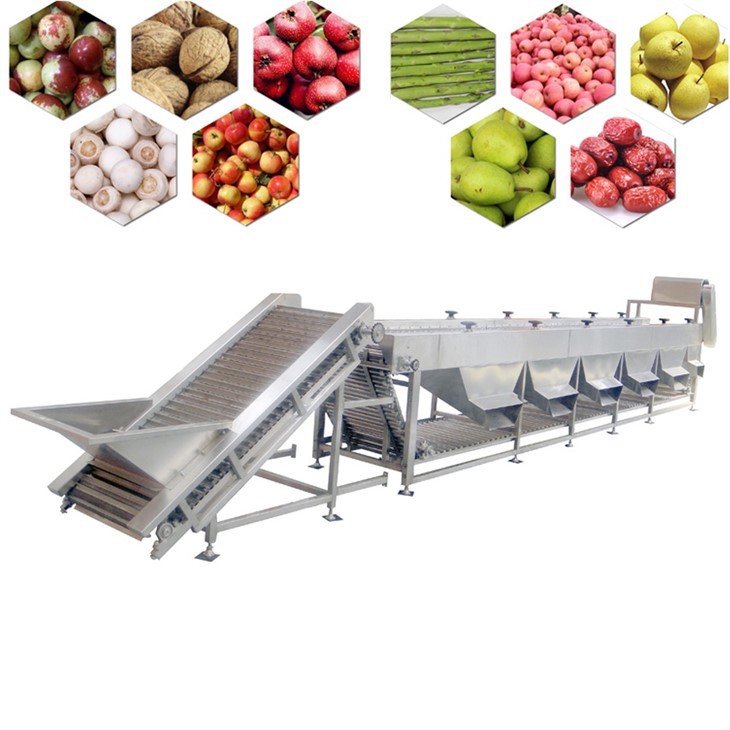


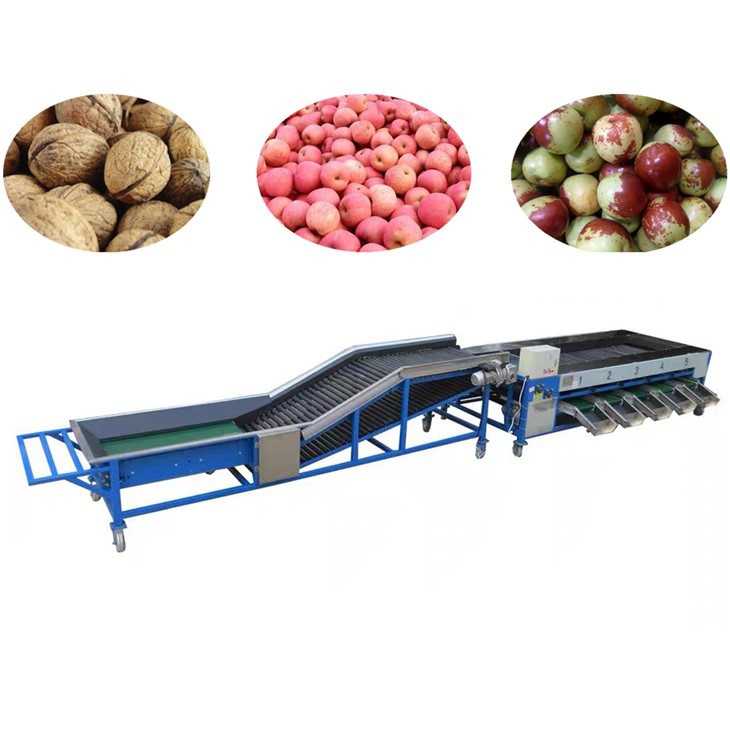
Zhengzhou Lerford Machinery Equipment Co., Ltd. is one of the most reliable manufacturers and suppliers of roller grader machine in China. With abundant experience, we warmly welcome you to buy advanced roller grader machine for sale here from our factory. Quality products and low price are available.
Roller graders obey one non‑negotiable law: size is fate.
Two raw material families actually make them pay off.
First up: fruits and vegetables – the delicate ones, let's be honest.
Peaches, apricots, cherries, oranges, tomatoes, dates, blueberries, potatoes, onions – the usual suspects.
Insider tip you won't see in any brochure: drop orange roller speed to 40 rpm max. Faster than that, you rupture the oil glands – bitter juice, whole load trashed.

Second: dried fruits and nuts – hard, bone‑dry, built for volume.
Walnuts, chestnuts, dried dates, and in‑shell peanuts.
But here's the kicker: shelled peanuts? Slick as ice. They'll just spin in place. Veteran operators dust on ≤2% food‑grade talc – barely enough to break the slip. Smarter move: skip them entirely.

One hard constraint – single‑layer feed, no exceptions. Pile it deep, and the small stuff never finds a gap. Grading goes out the window. Period.
Machine parameter introduction
| picture |
|
|
Feature |
Specification |
|
Grading Accuracy |
Up to 98% (Subject to material consistency) |
|
Number of Stages |
3 Stages (Standard); 2-6 Stages (Customizable) |
|
Roller Material |
Food-grade Polymer or Stainless Steel |
|
Frame Construction |
Heavy-duty reinforced steel with anti-corrosion coating |
|
Mobility |
360° Industrial Swivel Casters with locking brakes |
|
Material |
201&304Stainless steel |
|
Power Supply |
220V/380V(Customized per country standard) |

The grading channels are completely customized to the material – gaps, lengths, roller materials, and drive methods are all adjustable. You provide your production volume and the number of grades, and we'll provide the parameters. Contact us directly if interested.
Why it's worth buying:
Labor savings – One machine replaces 10–20 workers. Runs continuously. Slashes both labor costs and shift hours.
Quality assurance – Flexible rollers + gravity discharge = minimal bruising. Higher yield, better product appearance.
Easy customization – Roller gaps adjust on the fly. 2 to 6 sorting levels. Handles different varieties and size specs without retooling.
High durability – Mostly 304 stainless steel. Easy to clean, simple to maintain. Built for years of hard use.
Quick ROI – High throughput per square foot. Consistent quality gives you pricing power. You recoup your investment fast.

What kind of machine is this?
The roller-type fruit and vegetable grading machine is an automated device that achieves flexible, efficient, and multi-level sorting based on the diameter of the material through dynamically adjustable gaps. It is currently the mainstream grading solution for the initial processing of round/near-round fruits and vegetables.

What are the main advantages?
Choose the plan that suits you best.

Precise Dimensions
Purely physical diameter grading is stable and reliable.

Low Damage
Rolling conveyor, no squeezing or collision.

High Versatility
Changing product types only requires adjusting the gap.

Easy Maintenance
Mechanical structure, no complex electronic components.
To meet the grading needs of different fruits, vegetables, and nuts, and adapt to the full-scenario application from bulk rough processing to high-end refined sorting, our company has carefully developed and produced three series of grading equipment. The core positioning and core value of each piece of equipment are shown in the following table. Later, we will elaborate on the core characteristics, working principles, scope of application, and selection suggestions of each piece of equipment in detail.
| picture |
Equipment Series |
Core Positioning |
Core Value |
|---|---|---|---|
|
|
Drum Grader |
Efficient sorting equipment for bulk collision-resistant materials |
Simple structure, durability, and easy maintenance, helping with large-scale rough processing and reducing labor costs |
|
|
Roller Grader |
Flexible and refined sorting equipment for high-end fresh fruits and fragile materials |
Low damage, high precision, optimizing product appearance, and increasing product added value |
|
|
Belt Grader |
Special sorting equipment for irregular and long strip materials |
Strong adaptability, gentle sorting, balancing efficiency, and material integrity |


I sell all of the above products. Please contact us if you are interested.
What are the application scenarios?
Who is this equipment suitable for? Three types of customers: family farms, cooperatives, and processing plants.
Those seeking consistent grading. Your fruit should be uniformly sized, as if it were molded from a single mold. Domestic wholesalers may not care about this, but if you want to pursue a premium market, enter supermarkets, or build a brand, grading accuracy is crucial. The roller grading machine uses diameter-based positioning, controlling the error within ±2mm, which is far more reliable than manual sorting.
Targeting the export market. There's a strict rule for exported fruit: non-conforming specifications result in the entire container being returned. Buyers in the EU, the Middle East, and Southeast Asia specify diameter tolerances directly in their contracts. Manual grading? Three random inspections will expose the discrepancy. Roller grading results in minimal batch variation, giving customers a clear understanding of the process.
Ultimately, this equipment isn't for those who are "good enough." Family farms that only want to sell loose produce shouldn't buy it. Cooperatives without even a packaging line shouldn't rush into it. But if you've already secured orders from supermarkets, are negotiating export agency agreements, or want to establish a premium for your brand, then this machine is a standard feature on your production line.

Purchase Recommendations (Avoiding Pitfalls and Ensuring Success)
Purchase Recommendations – Avoid the Traps, Secure Your Line
Before you buy, get these three areas locked down.
1. Key parameters that actually matter
Throughput: 1–5 t/h – but be realistic. That top number is usually on dry, easy‑to‑grade material. Wet or sticky fruit? Expect less.
Grades: 2 to 6, field‑adjustable. More grades mean a longer machine – measure your floor space first.
Voltage: 220V or 380V. Don't assume; confirm single‑phase vs. three‑phase.
Material: 304 stainless steel. Non‑negotiable for fruit contact. Some low‑cost suppliers swap in 201 – it will rust. Don't let them.
2. Supporting components – what's included?
Elevator, sorting platform, damaged‑fruit conveyor. These are not free. Ask for a line‑item quote. An integrated layout does save space – but only if your plant layout is already tight. Measure twice, buy once.
3. After‑sales & customization – the real test of a supplier
They must provide hands‑on guidance for gap adjustment (every crop behaves differently). They must stock wear parts: rollers, bearings, and drive chains. For export buyers, they'd better offer on‑site installation and commissioning. If any of these are vague or missing, walk.
What are the reasons for choosing Lerford?
| Comparison Item | Lerford Roller Grader | Ordinary Manufacturer Roller Grader |
|---|---|---|
| Material | Thickened 304 stainless steel with food-grade certification | Ordinary 201 stainless steel, prone to rust |
| Grading Accuracy | Error ≤ 5%, precise gradual clearance | Large error, serious mixed sizes |
| Material Damage | ≤ 2%, gentle sorting | ≥ 10%, scratches and bruising |
| Customization | Full customization, suitable for 100+ materials | Fixed models, poor adaptability |
| Export Certifications | Complete CE, ISO, and SGS certificates | No certifications, not exportable |
| After-sales Service | Global after-sales, 1-year warranty, lifelong maintenance | No after-sales, spare parts not supplied |
| Service Life | 8–10 years | 3–5 years |
Choosing Lerford means choosing export-grade quality, professional customization, high efficiency and labor saving, long-term durability, and global after-sales service for roller grading machines. It can quickly improve grading efficiency and reduce losses, and adapt to the needs of export, supermarkets, and deep processing. It is the first choice for fruit and vegetable processing enterprises to reduce costs, increase efficiency, and enhance product competitiveness.
Related machine production lines
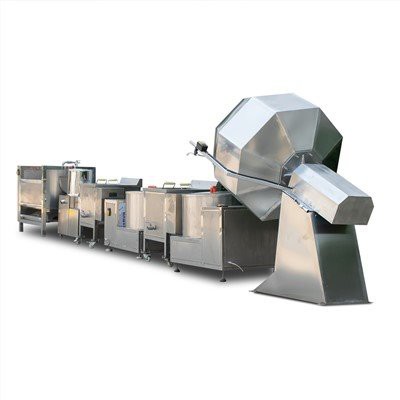
This isn't just a washing and grading line. It's a complete primary processing train. Seven stations in one continuous belt: lift, wash, knock off debris, dry, size‑grade, hand sort, then pack.
From dirty raw feed to boxed produce, it never stops. The sequence is fixed – deep wash, surface dry, size sort, manual culling, packaging – but here's what the brochure won't tell you: you'd better adjust each stage for the crop. Run citrus? Keep wash water below 15°C or you'll cook the oils. Potatoes? You can skip the dryer; wet skins won't hurt grading. Onions? Dry them hard before sizing; mud cakes the rollers.
The line handles round or oval stuff only. Apples, citrus, pears, potatoes, onions, dates, walnuts, cherry tomatoes, and passion fruit. Long or leafy? Don't even try – they'll jam the works.
Bottom line: farms, co‑ops, fresh‑cut plants, and export outfits rely on this as their backbone. It delivers uniform output, cranks volume, and cuts heads down. But only if you tune it right.

Summarize
The roller grading machine is a standardized sorting equipment with a simple structure, stable operation, no damage to materials, accurate grading, labor saving, and quick return on investment. It is an essential machine for fruit and vegetable planting, processing, and export enterprises to improve product quality, reduce costs, and enhance market competitiveness.
|
|
|
|
|
|


Everything You Need to Know
Roller grader machines are the most cost-effective general-purpose sorting equipment.
What standard does the roller grading machine use for grading?
It grades materials by diameter, automatically sorting them from smallest to largest through gradually increasing gaps between the rollers.
How many grades can it sort?
Standard grades range from 2 to 6, and can be customized according to customer needs.
What materials is it suitable for?
Round/oval fruits and vegetables such as apples, pears, oranges, tangerines, peaches, plums, potatoes, onions, garlic, walnuts, dates, and hawthorns.
Can it sort soft fruits? Will it damage the fruit?
Yes. The rollers provide flexible, rolling conveyor transport, without squeezing or bumping, making it suitable for delicate materials like apples and tangerines
Hot Tags: roller grader machine, China roller grader machine suppliers, factory, Date Sorting Machine