

Introduction of the concrete brick making machine
A cement brick making machine (also known as a block molding machine or concrete block machine) is an automated or semi-automated mechanical device that uses hydraulic or vibratory pressure to compress a mixture of cement, aggregates (such as crushed stone, sand, slag, fly ash, etc.), water, and other possible additives into bricks/blocks of a fixed shape and high density. This brick making machine is not only a molding tool but also a local resource transformation system. The machine produced by our company can transform readily available, even inexpensive, local waste materials (such as volcanic ash, mine tailings, construction waste, and specific types of soil) into standardized building materials, reducing reliance on long-distance transportation of clay bricks. It is particularly suitable for remote areas, infrastructure construction sites, and resource recycling projects.
Raw Material Substitution Rate of Our Machines: 30%-80% of local waste materials (such as fly ash, slag, tailings, and recycled construction aggregates) can be incorporated, directly reducing raw material costs.
Carbon Emission Reduction: Compared with sintered clay bricks, producing 10,000 standard cement bricks saves approximately 0.62 tons of standard coal and reduces approximately 1.5 tons of carbon dioxide emissions.
Transportation Optimization: Building a factory within 50 kilometers of the raw material source can reduce logistics costs and carbon emissions by 20%-40%.

Product Portfolio: From Basic Building Materials to Specialized Engineering Materials
The products produced by cement brick machines go far beyond traditional bricks, encompassing a product family that covers all scenarios in construction, municipal engineering, and landscaping.
1. Building Structure Category: Standard solid bricks, porous hollow blocks, U-shaped blocks, interlocking blocks
>> Customer Testimonial >>
"In our project in the Philippines, we used hollow blocks to build a 6-story apartment building. Compared to solid bricks, it saved 20% on cement consumption, reduced the overall weight of the building, and lowered foundation costs by 14%. It completely passed the local seismic tests." - Ramon G., Manila Construction Contractor
2. Municipal Engineering Category:
Permeable brick series, curb stones/road divider bricks, river embankment bricks, drainage ditch blocks
3. Landscape Decoration Category:
Split bricks/cultural stones, grass pavers, permeable grass parking lot bricks
4. Special Function Category:
Insulating blocks, soundproof blocks, and refractory bricks

Key Features:
Raw Materials: This machine can process aggregates with particle sizes ranging from 0-10mm fine sand to 5-40mm coarse crushed stone. For industrial waste such as fly ash and slag, the moisture content tolerance is 15%-20%. Through our raw material conditioning roller mill, even using C25-C30 low-grade concrete, it is possible to produce MU10-MU15 grade blocks.
Fixed Fully Automatic Production Line: Production capacity ≥10,000 blocks/8 hours, requiring only 2-3 operators, suitable for stable markets in urban areas.
Mobile/Simple Station: Investment is only 20%-40% of a fully automatic production line, enabling on-site production and saving 0.2-0.5 yuan/block in transportation costs.
Energy Consumption and Maintenance Optimized Design
Energy Consumption Data: The comprehensive power consumption for producing one standard brick with the fully automatic model is approximately 0.02-0.03 kWh.
Durability Data: The service life of the core mold steel is 300,000-500,000 pressing cycles, and the design life of the hydraulic system is ≥10,000 hours.

Molding System: Capable of rapid mold changeover
1. Mold Technical Specifications
Material Selection: High-chromium alloy steel (500,000-800,000 cycles) or wear-resistant steel (300,000-500,000 cycles)
Standardized Interface: 95% of molds are compatible with all models in the same series
Quick Mold Change System: Professional team completes mold changeover in ≤90 minutes
Number of Cavities: Available from single-cavity to 16-cavity options, balancing production volume and investment

FAQ of concrete brick making machine
Q1: Will using local waste materials affect product strength and durability?
A: No, but scientific proportioning is required. Data shows:
Adding 40% high-quality fly ash can improve later-stage strength (90-day strength is 15%-20% higher than 28-day strength) and improve workability.
Recycled construction waste aggregate needs to be cleaned and graded, controlling impurity content to less than 1%, and the strength of the produced blocks can fully meet the standards. The key is to determine the optimal ratio of "cement: local aggregate: additives" through experiments.
Q2: How to guarantee quality in extreme climate regions (severe cold/extreme heat)?
A: Data-driven process adjustment is key.
In severely cold regions (e.g., -30℃): We first need to perform steam curing (temperature 60-80℃, humidity >90%, curing for 8-12 hours) to ensure that the bricks reach 70% of the design strength within 24 hours and meet the freeze-thaw cycle standard of ≥F50.
In hot and dry regions, Water-retaining agents need to be added during the mixing stage, and automatic covering and spray curing should be used to ensure humidity for the first 72 hours, prevent cracking, and control strength loss to less than 5%.
Q3: What is the return on investment period?
A: The payback period largely depends on local brick prices, raw material costs, and production scale. A data model for a typical medium-sized semi-automatic project (investment of approximately 500,000-800,000 RMB) shows:
The static payback period is approximately 10-14 months. The payback period for a fully automatic production line is longer (2-3 years), but the long-term profitability and economies of scale are higher.
Q4: How to quantify the environmental performance of cement bricks?
A: Quantifiable environmental indicators include:
Resource consumption: 10,000 240x115x53mm cement bricks consume approximately 18 tons of industrial solid waste, saving 10 cubic meters of clay resources.
Energy consumption and emissions: Production energy consumption is only 1/3-1/2 of that of fired bricks, and there is no firing process, resulting in no SO₂, fluoride, or other exhaust emissions. Thermal performance: A 190mm thick hollow brick wall has a thermal resistance of up to 0.35 m²·K/W, which is superior to a 240mm thick solid clay brick wall (approximately 0.30 m²·K/W).
Related Machinery
Cement brick-making machines are core equipment in modern building materials production. Using a high-pressure vibration molding process, they rapidly transform cement, aggregates, and various industrial wastes (such as fly ash and construction waste) into standard building blocks. Compared to manual brick machines, they represent a leap from purely manual labor to mechanization – manual machines rely on manual compaction, resulting in low efficiency (only a few hundred bricks per day) and inconsistent strength, while cement brick machines are highly automated, producing thousands to tens of thousands of bricks daily with consistent quality. Compared to traditional clay brick machines, cement brick machines offer significant environmental and geographical advantages: clay brick machines consume arable land soil and require high-temperature firing, damaging the environment and consuming a lot of energy; cement brick machines, on the other hand, do not rely on specific soil types, can utilize large amounts of industrial waste, and can flexibly produce dozens of different products such as permeable bricks, insulation blocks, and curb stones by changing molds, precisely meeting diverse needs in municipal construction, ecological slope protection, and energy-efficient building. Therefore, cement brick making machines represent not only an upgrade in production efficiency but also a sustainable solution for green building and resource recycling.


Introduction to Small Brick Making Machine Production Line
This small cement brick-making machine production line consists of a roller mixer, belt conveyor, and main molding machine, achieving a compact and continuous operation from uniform raw material mixing and automatic conveying to high-pressure molding.


Summary of the concrete brick making machine
A cement brick making machine is far more than a simple molding device; it is a highly configurable, localized building material solution platform. Through its core feature of interchangeable molds and its ability to accommodate diverse raw materials, it can be deeply integrated into the economic, resource, and environmental systems of different regions, transforming geographical constraints into production advantages. It is a key tool for achieving a sustainable and resilient construction ecosystem. When selecting and operating such a machine, it is crucial to firmly adhere to the principle of "adapting to local conditions."

The company's product line covers everything from small mobile brick-making machines to fully automated large-scale production lines. Its core strength lies in its ability to deeply adapt to the raw materials and climate conditions of different regions, helping customers produce a variety of building materials, including standard blocks, permeable bricks, curb stones, and slope protection bricks.
Our address
No.10th, Yulan Road, High-Tech Industrial Development Zone, Zhengzhou City, Henan Province, China
Phone Number
+86-371-55960109
+8615838007835
goldenmachinerysusan@gmail.com

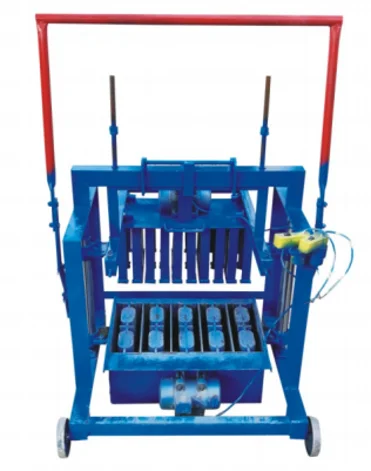
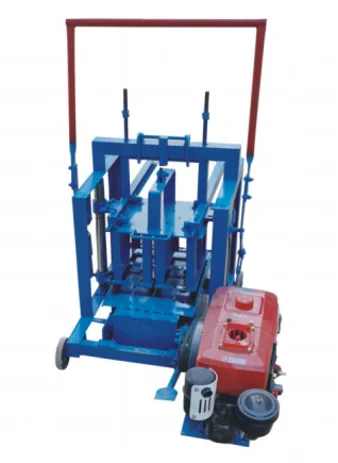
| Model | 2-45 | 3-45 | Diesel Moving | 4-45 | 4-35A | 4-35B |
| Image | 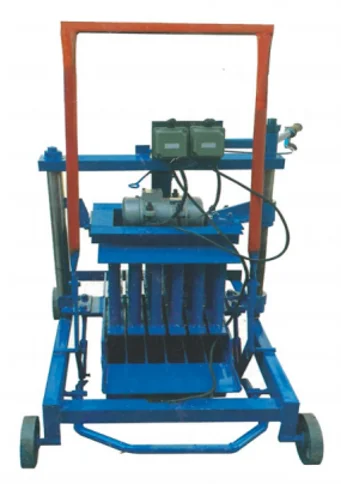 |
 |
 |
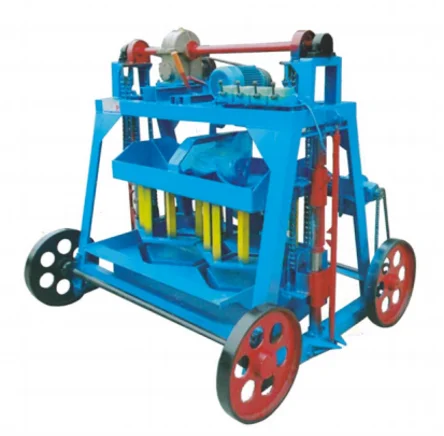 |
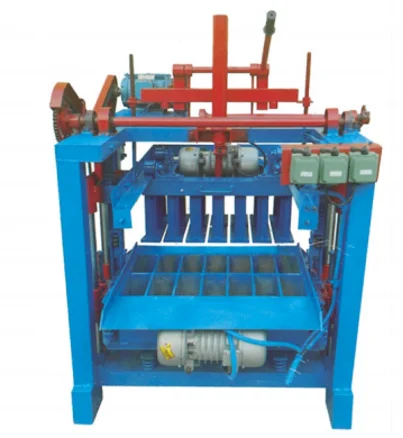 |
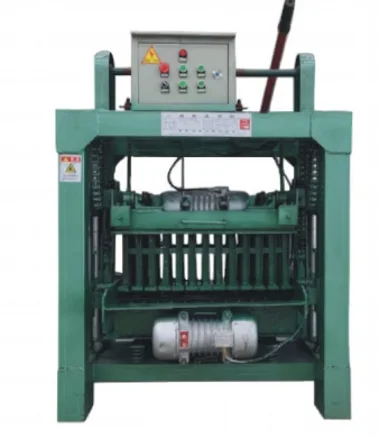 |
| Molding cycle | 45s | 45s | 45s | 45s | 35s | 35s |
| Equipped with power | 1.1 | 1.1 | 8P | 3.7 | 4.8 | 4.8 |
| Class is produced(block) | Standard block:240*53*115mm - 3600pcs Hollow brick: 390*190*190mm - 600pcs | Standard block:240*53*115mm - 8000pcs Hollow brick: 390*190*190mm - 1000pcs | Standard block:240*53*115mm - 3600pcs Hollow brick: 390*190*190mm - 600pcs | Standard block:240*53*115mm - 12000pcs Hollow brick: 390*190*190mm - 1800pcs | Standard block:240*53*115mm - 15000pcs Hollow brick: 390*190*190mm - 2400pcs | Standard block:240*53*115mm - 15000pcs Hollow brick: 390*190*190mm - 2400pcs |
| Packing Size | 1030*800*1080 | 820*1220*1100 | 1900*1400*1099 | 1300*1300*1700 | 1260*1370*1649 | 1250*1350*1750 |
| Weight | 200kg | 300kg | 250kg | 750kg | 750kg | 800kg |
| Number of operators | 1-2 worker | 1-2 worker | 1-2 worker | 2-3 workers1 | 2-3 workers | 2-3 workers |
| Features | 110v-220v-380v voltage can be used,mobile brick directly hit the bricks on the ground,convenient and fast,electricity consumption is small,energy saving and environment protection. | 110v-220v-380v voltage can be used,mobile brick directly hit the bricks on the ground,convenient and fast,electricity consumption is small,energy saving and environment protection. | Diesel engine type brick machine,a multi-purpose machine,can be replaced by a variety of mold to produce various specification of cement products. | 110v-220v-380v voltage can be used,mobile brick directly hit the bricks on the ground,convenient and fast,electricity consumption is small,energy saving and environment protection. | 220v-380v voltage can be used,mobile brick directly hit the bricks on the ground,convenient and fast,electricity consumption is small,energy saving and environment protection. |
Hot Tags: concrete brick making machine, China concrete brick making machine suppliers, factory