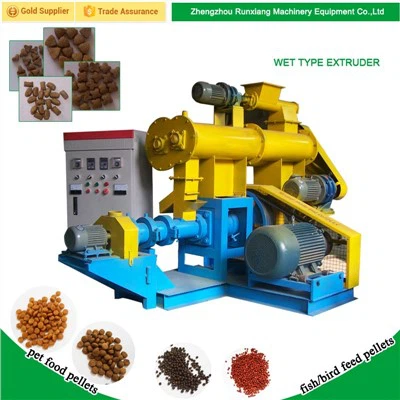


Working Principle of Floating Fish Feed Production Line:
The process of manufacturing floating fish feed follows several stages, including mixing raw materials, grinding, mixing, conditioning, pelleting, cooling, and packaging. The working principle of the floating fish feed machine revolves around the pelleting, cooling, and packaging stages.
Pelleting Stage
The pelleting stage involves compressing the mixed raw materials with a combination of heat and moisture to form pellets. At this stage, the raw materials used to manufacture the fish feed, such as wheat bran, bone meal, and soybean meals, undergo processing as the heat softens the starches and other carbohydrates in the mixture, which then bind the mix together.
Cooling Stage
After the pellets are formed, the next step is to cool them to stop the processing reaction and harden the exterior. The pellet-cooling process aims to stabilize and preserve the quality of the pellets. Therefore, it is a vital stage in the entire fish feed production process.
Packaging Stage
The packaging stage involves sealing the floating fish feed into air-tight packages. This prevents the feed from exposure to humidity, oxygen, and other elements that may affect the in-feed nutrients.

What are the Parameters of the Machine?
The parameters of the machine determine the output efficiency, processing speed, and quality of the final product. Some of the essential parameters of the machine include processing capacity, pellet size, crusher power, molder power, cutting power, and steam consumption.
Processing Capacity
The processing capacity is the amount of raw materials the production line can transform into pellets within a specified time. A higher processing capacity translates to higher production efficiency.
Pellet Size
The pellet size determines the rate of decomposition and consumption by the fish. Therefore, the size should work for the specific fish breeds and stage of the fish life.
Crusher Power
The crusher's power determines the rate of grinding the raw materials to a finer powder, ideal for pelleting. A higher crusher power equates to a higher mixing speed, increasing the output.
Molder Power
The molder's power is responsible for determining the strength of the pellets. The stronger the pellets, the longer they will float, ensuring better nutrition utilization by the fish.
Cutting Power
The cutting power determines the rate at which the pellets are cut into uniform sizes to ensure packaging consistency.
Steam Consumption
The steam consumption tells the cost of running the production line, and a high steam consumption rate indicates higher production costs.

How to Choose the Suitable Fish Feed Processing Line?
The specific processing line needed will depend on several factors, including expected production capacity, number of varieties, the species of fish, and the expected pellet size. Some of the critical aspects to consider when choosing the right processing line includes:
Production Capacity
The production capacity should align with the actual capacity needed, and the machine chosen should have enough capacity to meet future expansion needs.
Variety
The production line chosen should offer several varieties of pellet sizes, shapes, and compositions to cater to different species and developmental stages.
Quality
The processing line must provide high-quality pellets with high nutrient bioavailability for maximum fish growth and development.
Machine Price
The value of the Processing line should align with the capacity and functionality, ensuring that the line's cost is commensurate with the expected return on investment.
Production Efficiency
The processing line should offer high production efficiency, which translates to higher outputs of quality products per unit time.
How to Use the Machine?
The floating fish feed machine is easy to use in operation. The process involves the following steps:
Step 1: Material Selection
Select the appropriate raw materials that align with the fish species and stage of growth.
Step 2: Grind the Materials
Grind the raw materials to the desired size and consistency for proper mixing.
Step 3: Mix the Raw Materials
Mix the raw materials in the appropriate ratio and add water to create a moisture range of 12-15%.
Step 4: Pelletize the Mix
Feed the mixed raw materials into the pellet mill to obtain the desired pellet size and shape.
Step 5: Cool the Pellets
The pellet cooling process aims to stabilize and preserve the quality of the pellets.
Step 6: Package the Pellets
Pack the pellets into air-tight packages to preserve the quality and nutrients in the product.
What are the Advantages of Our Factory?
Our factory specializes in providing floating fish feed production lines that cater to various capacity needs, pellet sizes, and specific breeding requirements, offering the following advantages:
· High Durability
Our machines are constructed with high-quality materials that offer longer lifespans and less wear and tear.
· Easy-to-use and maintain
Our machines come with user manuals and are easily adaptable, making operation and maintenance stress-free.
· Customization
We build custom machines that align with specific capacity and production needs from our clients.
· Cost-effective
Our machines offer the right balance between cost and quality, offering high-quality machines at affordable prices.
· Fast delivery
At our factory, we understand the value of time in agribusiness, and we prioritize swift delivery of equipment after placing an order.
Conclusion
Floating fish food machines are essential aspects of the aquaculture industry, and choosing the right equipment is a vital step in ensuring optimal fish growth and development. Our factory provides quality machines that are easy to use, maintain, cost-effective, and customizable to meet customers' specific needs. Choose our factory and enjoy the benefits of quality floating fish food machines.
|
Model |
WSJY-40 |
WSJY- 50 |
WSJY-60 |
WSJY-70 |
WSJY-80 |
WSJY-90 |
WSJY-120 |
WSJY—135 |
WSJY-160 |
WSJY-200 |
|
Capacity --- kg/h |
30-40 |
60-80 |
120-150 |
180-250 |
300-350 |
400-450 |
500-700 |
800-1000 |
1200-1500 |
1800-2000 |
|
Pelleting Diameter--- mm |
1-8 |
1—8 |
1 —10 |
1-10 |
1 —10 |
1 —10 |
1-10 |
1 –12 |
1-12 |
1-12 |
|
Motor Power--- kw |
5 |
7.5 |
15 |
18.5 |
22 |
37 |
55 |
75 |
90 |
132 |
|
Cutting Power--- w |
400 |
400 |
400 |
400 |
1100 |
1500 |
2200 |
2200 |
2200 |
3000 |
|
Screw Rod Diameter-- mm |
40 |
50 |
60 |
70 |
80 |
90 |
120 |
135 |
160 |
200 |
|
Cooking degree |
>95% |
>95% |
>95% |
>95% |
>95% |
>95% |
>95% |
>95% |
>95% |
>95% |
|
Size(m) |
1.4*1.03*1.1 |
1.45*1.08*1.25 |
1.46*1.14*1.25 |
1.6*1.4*1.35 |
1.6*1.4*1.35 |
2.1*1.45*1.35 |
2.1*1.45*1.35 |
2.55*2.05*1.65 |
2.9*2.65*1.8 |
3*2.85*1.9 |
|
Weight(kg) |
260 |
350 |
355 |
580 |
700 |
950 |
1700 |
1900 |
3600 |
4300 |
Hot Tags: floating fish feed production line, China floating fish feed production line suppliers, factory, Feed Pellet Line