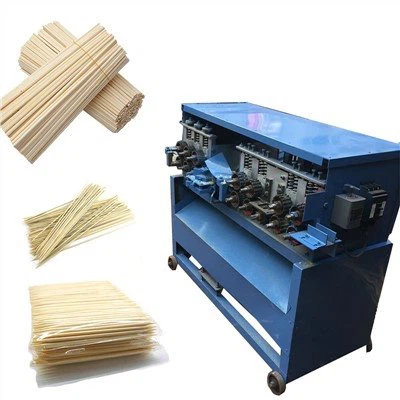



Our production line utilizes natural Moso bamboo to manufacture disposable bamboo skewers through a fully automated process. It produces a wide range of specifications-including skewers for outdoor grilling, sausages, *chuan chuan xiang*, hot pot, fruit, and *mala tang*-making it ideal for mass production by food service suppliers, manufacturers of daily-use goods, and export-oriented bamboo processing plants.
What it does
This line turns raw moso bamboo into barbecue skewers-fast and in bulk. It fits home workshops, mid‑size mills, and export factories alike.
Feeding it
You can feed in bamboo of just about any thickness or length straight off the truck. No need to sort it first.
Dialing in sizes
Swap out the cutting tools, and you can set thickness from 2.0 mm to 6.0 mm and length from 10 cm to 40 cm. That covers everything from small food stalls and BBQ joints to big cross‑channel retailers.
The result
Skewers come out smooth, splinter‑free, and tough-they don't snap easily. Plus they meet food‑contact safety standards.
Complete Barbecue Skewer Production Line
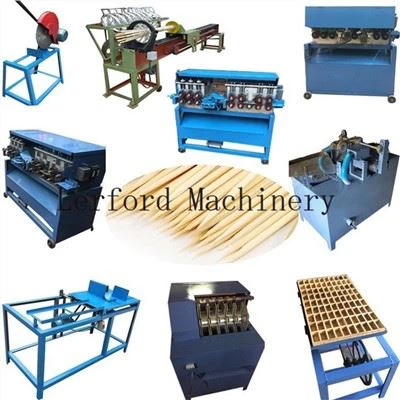
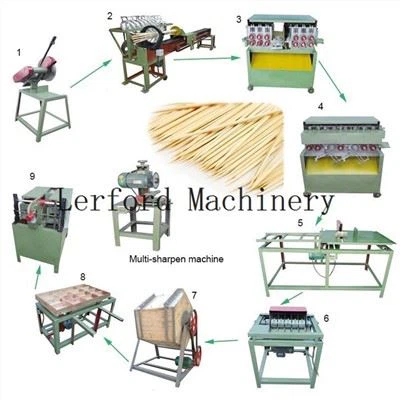
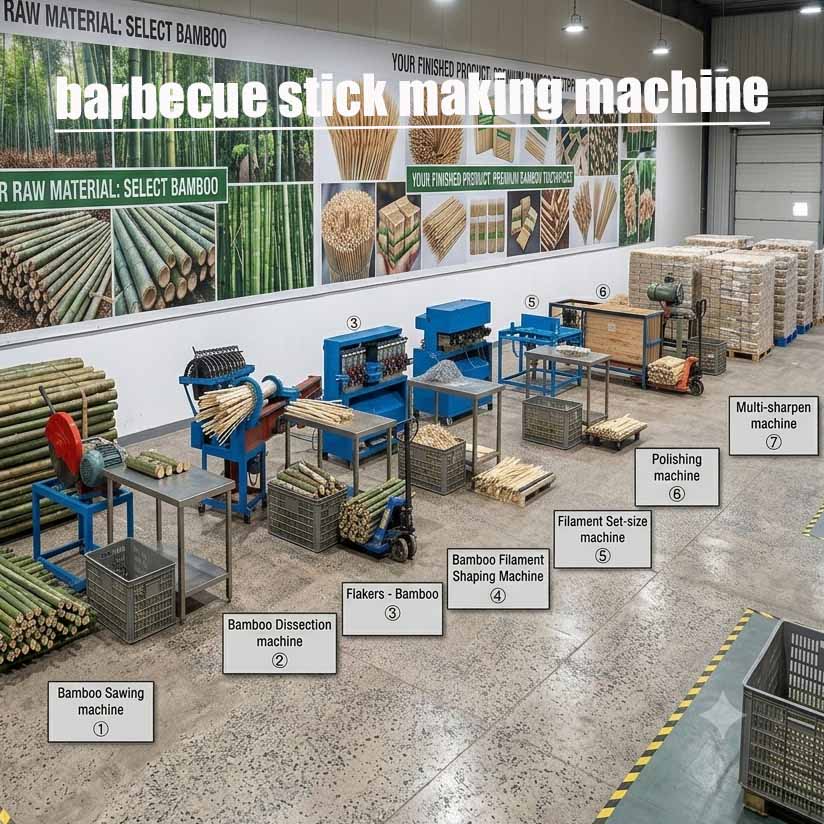
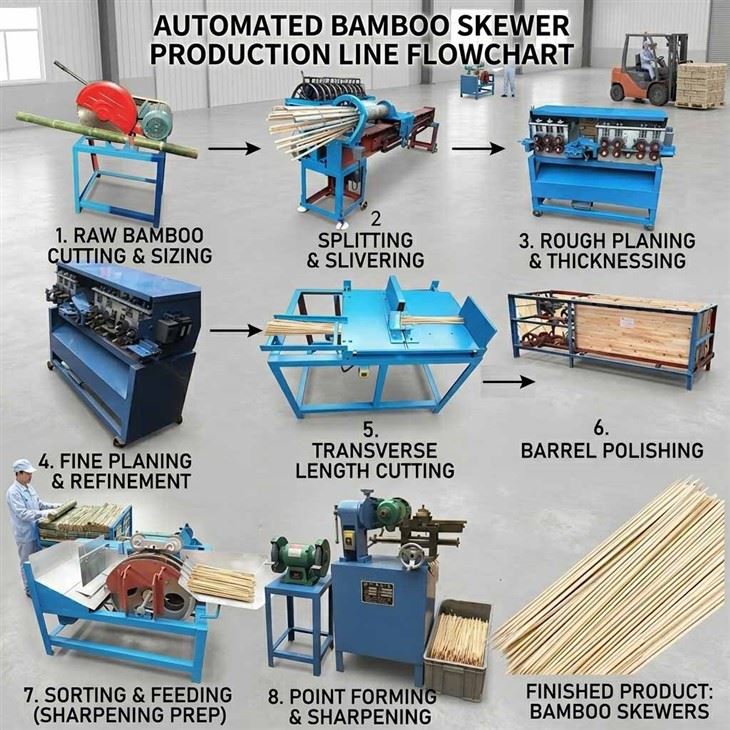
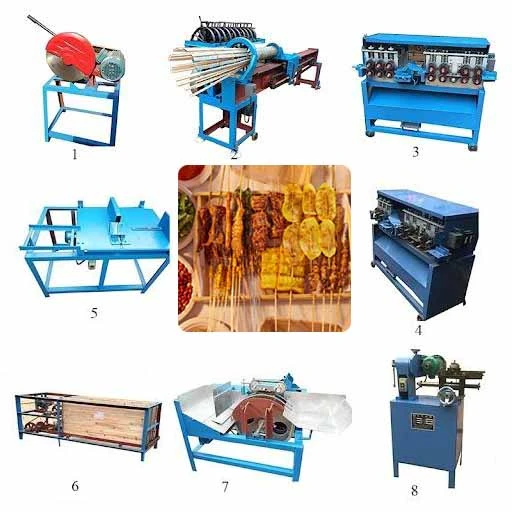
Lerford's production line utilizes raw bamboo as its starting material, processing it through a continuous sequence of seven specialized machines-cutting, splitting, slicing, wire-drawing, sizing (width and thickness), polishing, and sharpening-to yield finished bamboo barbecue skewers. Let's take a closer look at these machines.
How we started

01
Bamboo Sawing machine ANY
This machine does the first job: cutting whole Moso bamboo stalks into sections. Its sturdy base keeps it steady, and the cuts come out clean and smooth-no splitting. An electric motor gives it high cutting speed. It also trims off the unusable butt and tip, keeping only the sound middle sections, so the next step (splitting) gets a uniform batch of raw material to work with.

02
Bamboo Dissection machine
Next, the pre‑cut bamboo sections go through a splitter. Inside, a row of circular blades runs the full length of the bamboo in one go, splitting it into several equal‑width strips. That turns the round culm into flat pieces and knocks out the inner joints along the way. Since all blades cut at once, you don't need manual splitting-labor drops way down. The strips come out even in width, so they feed straight into the planer without extra fuss.

03
Flakers - Bamboo
Next, the rough split strips go through a planer. This machine shaves off the tough outer green skin and the rough inner pith, keeping just the good middle layer-the bamboo flesh. The strips are fed between upper and lower rollers while rotating blades do the cutting, taking off both sides at once. What comes out? Thin strips with even thickness and a smooth surface, no hard skin left. That means when you draw them into final shape, you won't get splinters, and the material stays evenly tough-so your finished skewers won't discolor or break under use.

04
Bamboo Filament Shaping Machine
Input material: Standard, planed thin bamboo strips;
Processing action: An array of precision-molded rotary cutters longitudinally cuts and draws the bamboo strips into continuous, slender bamboo strands;
Key outcome: Produces continuous, long bamboo strands with a diameter approximating that of a toothpick blank; this is the core shaping stage, yielding strands of uniform thickness and serving as a pre-processing step for the length-cutting machine.

05
Filament Set-size machine -- Bamboo&Wood
Input material: Continuous bamboo strips;
Processing steps: Dual-layer shaping rollers calibrate the width and thickness of the bamboo strips, while an integrated cutter slices the long strips into segments of standard toothpick length;
Output (semi-finished product): Uniformly sized toothpick blanks-fully standardized in length and thickness-facilitating subsequent polishing

06
Polishing machine
Functions: Deburring, chamfering, and surface brightening.
Input material: Toothpick blanks cut to fixed lengths.
Processing method: Rotary polishing chamber containing polishing media for batch tumbling and abrasion.
Product improvements: Removal of cutting burrs and bamboo splinters; rounded edges; smooth, refined surface finish free from rough spots or scratches; enhanced visual appeal; and removal of dust and debris.

07
Multi-sharpen machine -- Bamboo&Wood
Once the blanks are polished, they move to the sharpening stage. High‑speed grinding heads on both ends-with automatic feed-taper each end to a sharp point in one pass. The tips come out even and sturdy, not prone to snapping. This completes all shaping steps; the skewers are ready for immediate packaging.

08
Knife sharpening machine
There will be different blades on the above machine; the blade needs to be polished after 2-3 months of use to make the blade sharper.
High‑volume skewer production chews through cutting tools fast. Replacing them all the time gets pricey. So Lerford throws in a multi‑head sharpening machine with every full line package-saves you money on running costs. Here's a quick look at the specs for each machine. Want more info? Just click the button below to get in touch
|
|
Name |
Model |
Power kw |
Weight KG |
Size cm |
|
1 |
Sawing machine |
ZJ-791 |
1.5 |
58 |
120*50*105 |
|
2 |
Bamboo dissection machine |
ZJ-388 |
4 |
650 |
310*70*125 |
|
3 |
Flakers |
ZJ-275 |
3.3 |
310 |
130*65*103 |
|
4 |
Bmaboo filament shaping machine |
ZJ-144 |
7.1 |
400 |
100*65*108 |
|
5 |
Filament set-size machine |
ZJ-741 |
0.75 |
80 |
140*66*88 |
|
6 |
Polishing machine |
ZJ-542 |
1.5 |
130 |
215*70*85 |
|
7 |
Skewer sharpening machine |
ZJ-641 |
1.99 |
250 |
125*75*95 |
|
8 |
Multi-sharpen machine |
TJ-803 |
0.37 |
65 |
75*50*95 |
|
|
Total |
|
34.06 |
2683KG |
11.5m3 |
What raw materials are used?
The requirements for raw materials commonly used in barbecue stick making machines include
Raw material: Mature bamboo (Nan, Shui, etc.) and softwoods-poplar, fir. Offcuts from either are recycled into smaller skewers.
Condition: Fresh, moist, 3+ years old.
Diameter: 4–10 cm standard; up to 15 cm without modification. Bigger? We supply custom splitter blades.

Why is this production line worth purchasing?
This line runs with just one or two operators-mostly for loading and collection. The seven machines are linked and feed automatically, so you don't need extra hands for splitting, sanding, or pointing like you would with manual processing. That cuts labor costs over the long haul.
On quality, the peeling step strips off the hard outer layer, leaving skewers that are uniformly white and clean-no dark spots, rough patches, or splinters. Multiple sizing stations keep thickness and length consistent within each batch, and the polishing and pointing steps give you a smooth shaft with a rounded tip that pierces meat and vegetables easily without crushing them or leaving scratches.
Switching specifications is straightforward: change the internal blades and adjust the conveyor gaps, and you can go from thin fruit picks to standard BBQ skewers to thick ones for large cuts. Length is adjustable too, so you can run export and domestic orders on the same line-no need for separate equipment.
The cutting tools use steel formulated for bamboo and wood, which minimizes splits and breakage. Offcuts from the ends get reprocessed into smaller skewers, pushing overall material use above 90% and lowering your raw material costs.
The main frame is thick carbon steel, and the drive components use wear‑resistant bearings. Blades are easy to swap out or sharpen-no specialist needed. Few parts tend to fail, and routine cleaning and lubrication are all it takes to keep the line running 24/7.
The footprint is moderate, so it fits in small workshops or standard factory bays. Power is configurable to your local voltage-domestic or export-making it a practical choice whether you're a local processor or an exporter.
What is the workflow?
The process utilizes fresh Moso bamboo-aged at least three years, kept moist, and with a diameter of 4–10 cm (custom splitting blades are available for thicker bamboo up to 15 cm)-though poplar, fir, and bamboo/wood offcuts can also serve as raw materials. Whole bamboo culms are first fed into a cutting machine to be sectioned into standard lengths, then split by a splitting machine to remove the nodes and yield rough bamboo strips. These strips are conveyed to a planing machine to remove the outer green skin and inner yellow layer, producing strips of uniform thickness that are subsequently fed into a drawing machine to create continuous bamboo strands. These long strands are calibrated and cut to standard skewer lengths by a sizing and shaping machine; the cut blanks are then batch-polished to remove burrs and fed into a multi-head pointing machine to sharpen the tips, resulting in finished barbecue skewers. Using the multi-head pointing machine helps reduce tool wear on upstream equipment and lowers the cost of replacing consumable parts. Finally, the finished skewers are sorted, washed, dried, and packaged for sale.

What are the application scenarios for the finished product?

The finished products from our barbecue skewer production line are highly versatile, suitable for a wide range of applications beyond just barbecue:
Foodservice & BBQ Outlets: Skewers for outdoor grilling, night market meats, deep-fried skewers, *Oden*, and grilled gluten;
Snack Retail: Skewers for candied fruit (*tanghulu*), grilled sausages, spicy skewers, cold-pot skewers (*lengguo chuanchuan*), and *Bobo* chicken;
Baking & Desserts: Fruit skewers, decorative picks for pastries, cheese skewers, and disposable fruit-tasting picks;
Retail & Household Goods: Packaged disposable bamboo skewers and skewers included in home BBQ kits;
Crafts & Floral Art: Floral stems, DIY craft skewers, and simple sticks for aromatherapy diffusers.
Related machinery
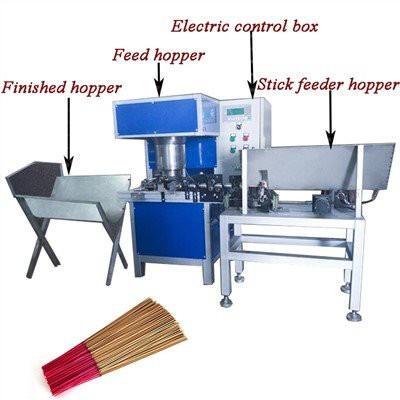
The complete automated bamboo barbecue skewer production line originally comprised eight processing stages capable of consistently producing standard, smooth bamboo skewer blanks. By adding a specialized incense stick machine to this existing setup-without requiring any modifications to the main production line equipment-the entire processing workflow for incense sticks can be completed in a single, integrated operation.

Why choose Lerford?
The machines are tough-carbon steel frames, heavy-duty bearings, not much that breaks. Swap blades in a few minutes. A quick wipe and a drop of oil each day, and they run 24/7. You don't need a mechanic on payroll.
Costs? We've got that covered. Every line comes with a sharpener, so blade replacements won't sneak up on you. The cutters are bamboo-specific-clean cuts, little waste. Even the end pieces get turned into small skewers. You end up using over 90% of the raw material, which keeps your bamboo bill lower.
And we stay with you. Before you buy, we help you figure out what you need. After delivery, we handle installation, testing, and training until your people are comfortable. No guessing. No panic if something stalls-we're a phone call away.
So what's the takeaway? Gear that lasts, costs you can plan for, a line that adapts to different orders, and real people who actually answer when you call.
|
|
|
|
|
|


Summarize
Just load the bamboo, and the line does the rest-seven operations in one continuous run, plus an onboard sharpener so blades stay sharp longer. It's built solid, easy to use, and handles pretty much any skewer job you need. Drop us a line if you're interested.
FAQ
Q: What raw materials can the barbecue stick making machine process?
A: It can process fresh, moisture-retaining moso bamboo aged three years or older (diameters of 4–10 cm; blades for up to 15 cm are available upon request). It is also compatible with softwoods like poplar and fir, and can even reprocess bamboo or wood offcuts/scraps into small skewers (depending on the specific machine model).
Q: Is it better to process dry or wet bamboo?
A: Fresh, semi-moist bamboo is ideal. Fully dried, hard bamboo accelerates blade wear, while excessively wet bamboo tends to stick to the blades and cause damage.
Q: Can this equipment be used to make wooden skewers if there is no local bamboo available?
A: Yes, it is possible. Minor parameter adjustments are required, and producing wooden barbecue skewers may simply involve swapping out the main processing unit of the production line.
Can I purchase a single machine separately, without buying the entire set?
A: Yes, individual machines are available for purchase; however, a complete, integrated production line offers higher efficiency and lower overall production costs.
Hot Tags: barbecue stick making machine, China barbecue stick making machine suppliers, factory, Bamboo Stick Making Machine, Chopstick Machine, Home Made Machine, Incense Stick Making Machine, Toothpick Machine, Toothpick Production Line