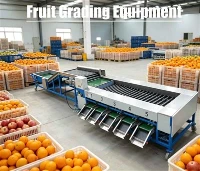


Aiming at the problems of low production efficiency and inaccurate grading of the existing walnut classifier, on the basis of the original roller classifier, grid classifier and drum classifier, combined with the actual production situation in the whole area, a new A high-efficiency and high-precision roller type green walnut classifier is introduced. The working principle, main component design and structural characteristics of the roller type green walnut classifier are introduced.
In recent years, with the increase in the scale of walnut planting and the arrival of the full fruit period, the output of green walnuts that need to be processed has risen sharply. In addition, the harvesting period of walnuts is relatively concentrated, and the processing period is only about 15 days. The processing scale of green walnuts is large, and many walnuts are If it is too late to peel, the kernels will be moldy and discolored. If the green peel of the walnut cannot be peeled off in time, the quality of the walnut will be seriously affected. The processes of walnut harvesting, peeling, cleaning, drying, shell breaking and separation of shell kernels have been preliminarily realized mechanization. However, the harvested walnuts cannot be de-greened directly by mechanization. Instead, they are first graded according to different sizes, and walnuts of different grades are processed separately, so as to reduce the walnut fruiting rate, reduce labor intensity, improve efficiency and walnut quality, and realize walnut quality. commoditization.
The existing classifiers mainly include drum classifiers, grid classifiers, and roller classifiers. The key component of the drum classifier is the drum, which is usually punched and rolled with thin steel plates. The drum is divided into several groups, and the number of groups is minus 1 for the required grading level. There are many small holes on the drum, and each group of small holes has different diameters, but the same group has the same diameter. From the material inlet to the outlet, the hole diameter of the rear group is larger than that of the front group, and the material smaller than the hole diameter of the former group falls out from the former group and is collected into a level with a funnel, and the following analogies are repeated. When working, the screened material enters the screen cylinder from the feeding device, and rises along the inner wall of the rotary screen cylinder. When it rises to a certain height, it loosely falls down. In this way, the material continuously entering the screen cylinder is subjected to the action of pressure and lifting force. .