
March 27, 2026
We will break down the differences between these two devices in detail from six dimensions: product positioning, structural principles, production efficiency, operation and maintenance, applicable scenarios, and return on investment, so that you can make an accurate selection.

Core Product Positioning and Finished Product Differences
| Comparison Item | Single-head Solid Meatball Machine (Left) | Double-head Stuffed Meatball Machine (Right) |
|---|---|---|
| Main Products | Pure solid meatballs (Teochew beef balls, pork balls, fish balls, chicken balls, etc.) | Stuffed meatballs (soup-filled beef balls, juicy meatballs, cheese burst balls, mushroom meatballs, etc.) |
| Finished Product Texture | Firm, chewy, and elastic texture, no filling, replicating the taste of handmade meatballs | Elastic outer skin with juicy/flowing filling, rich in layers, more attractive in both appearance and taste |
| Market Differentiation | Traditional classic style, wide audience, suitable for general catering and household consumption | Internet-famous / specialty style, ideal for creating bestsellers, attracting young consumers, with higher premium space |
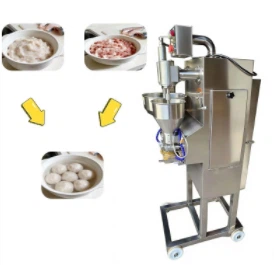
| Finished Product |
|
|


Structural Composition and Working Principle
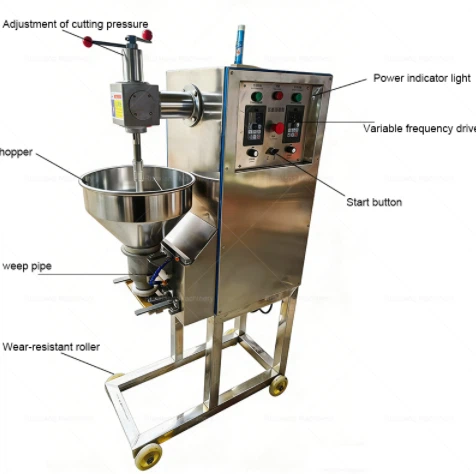
Single-Head Solid Meatball Machine
Structural Composition: All stainless steel body + hopper + single spiral extrusion molding system + adjustable discharge nozzle + casters
Core Components: Spiral propeller, molding die, speed control device
Working Principle: We need to process the meat chunks with a meat grinder before pouring them into the hopper. The propeller extrudes the meat filling at a uniform speed. Then, the forming mold cuts the meat filling into uniformly sized solid meatballs, which are then placed directly into warm water or a forming tank to set.
Features: Extremely simple structure, no complex piping or double hopper design, extremely low failure rate.
Double-Head Stuffed Meatball Machine
Structural Composition: Dual hopper design (outer skin hopper + inner filling hopper) + double helix propulsion system + pneumatic/mechanical wrapping device + control panel + forming and cutting mechanism
Core Components: Double helix propeller, wrapping mold, flow regulating valve, pneumatic control components
Working Principle: The two hoppers are respectively filled with outer skin meat paste and inner filling (broth/minced meat/cheese, etc.). Through precise flow control, the outer skin meat paste wraps around the inner filling and is extruded simultaneously, then cut into complete stuffed meatballs, achieving "outer skin + inner filling" in one step.
Features: Precise structure, requiring higher precision in flow rate, speed, and proportion adjustments, resulting in higher technological barriers.
What are the advantages of these two machines?
Single-barrel meatball machine advantages (focusing on flexible production):
✅ Highly efficient changeover – Complete product switching within 10 minutes (e.g., from beef meatballs → fish balls → shrimp balls) without disassembling core components;
✅ Convenient cleaning – The entire machine can be quickly disassembled, and key modules support water/steam quick cleaning, completing full cleaning and resetting within 30 minutes.
✅ Flexible adaptation – Designed specifically for scenarios with multiple varieties, small batches, and high line changeover frequency, meeting customized, seasonal, and trial production needs.
Double-barrel meatball machine advantages (focusing on economies of scale):
✅ High efficiency and stability – Dual-station continuous operation, suitable for large-scale, long-cycle production of a single popular stuffed meatball (e.g., classic pork stuffed meatball);
✅ Optimal cost – Unit energy consumption and labor costs are reduced by approximately 22%, amortizing mold, raw material, and management costs, resulting in a shorter ROI cycle.
In terms of operation difficulty and maintenance cost
| Dimension | Single-head Solid Meatball Machine | Double-head Stuffed Meatball Machine |
|---|---|---|
| Operation Difficulty | Extremely low. New operators can get started within 1 day; they only need to adjust the discharging speed and meatball size. | Relatively high. Requires 1–3 days of training; operators need to master the proportion of outer meat and inner filling, speed synchronization, and sealing pressure adjustment. |
| Cleaning Difficulty | Easy to disassemble and clean. Adopts a single hopper and a single propeller without complex pipelines. The whole machine can be cleaned in 15 minutes. | Complicated. Equipped with double hoppers, double propellers, a sealing mechanism, and pneumatic pipelines. More parts need disassembly, and the cleaning time is about 30–45 minutes. |
| Maintenance Cost | Low. Few vulnerable parts (mainly forming molds and sealing rings) with a low replacement cost. | High. Numerous vulnerable parts, including double propellers, stuffing molds, pneumatic valves, and flow control valves; high technical requirements for maintenance personnel. |
| Failure Rate | Extremely low. Simple structure with almost no complex malfunctions. | Moderate. Improper flow proportion adjustment may cause filling leakage, skin breakage, and uneven product size. |
Applicable Scenarios and Return on Investment
1. Scenarios Suitable for a Single-Head Solid Meatball Machine:
You are a small restaurant/workshop specializing in traditional, solid meatballs, primarily serving customers in the surrounding community and farmers' markets. (Related article: How to make money by setting up a stall using a meatball-making machine)
You have a limited budget and want to keep the initial investment low (single-head machines are typically 10% cheaper than stuffed meatball machines).
You have a wide variety of products and need to frequently change production (e.g., making beef balls, fish balls, and chicken balls simultaneously).
You have extremely high requirements for product texture, seeking a firm and bouncy, handmade feel.
2. Scenarios Suitable for a Double-Head Stuffed Meatball Machine:
You are a food processing plant/central kitchen planning to create popular stuffed meatball products (such as beef balls or cheese balls).
Your target customers are supermarkets, e-commerce platforms, and chain restaurants, requiring large-scale supply.
You want to increase premium pricing through product differentiation, pursuing a trendy/specialty food strategy.
You have a professional operation and maintenance team capable of handling complex equipment debugging and maintenance.
Both machines are very easy to operate. If you have any questions, feel free to call or email us. We'll respond within 24 hours on weekdays.
Additional Selection Recommendations:
Raw Material Compatibility:
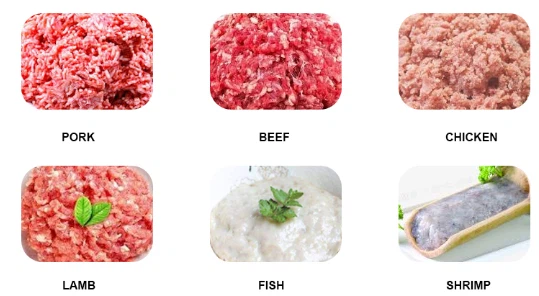
If the raw material is coarse-fiber meat (such as beef or lamb), the single-head machine's extrusion molding better preserves the meat's elasticity, resulting in a better texture.
If the raw material is fine meat paste (such as fish paste or chicken paste) and requires wrapping a flowing filling, a double-head filling machine is the only option.
Future Expandability:
If you currently only produce solid meatballs but want to expand your product line to include filled meatballs, prioritize a basic single-head machine that supports filling module upgrades to avoid redundant investment.
If you have already decided to focus on filled meatballs, directly purchase a high-end double-head filling machine for superior efficiency and stability.
Compliance and Hygiene:

Both machines are made entirely of stainless steel, meeting food-grade hygiene standards.
Due to the complex structure of the filling machine, extra attention needs to be paid to the cleaning design of the pipework's hard-to-reach areas to prevent dirt and grime buildup.
Final Decision Recommendation:
Left (Single-head Solid Core Machine): Traditional approach, small batch production, low cost, easy to operate, stable and reliable.
Right (Double-head Core-wrapping Machine): Innovative approach, large-scale production, high profit margin, technology-driven, suitable for creating blockbuster products.